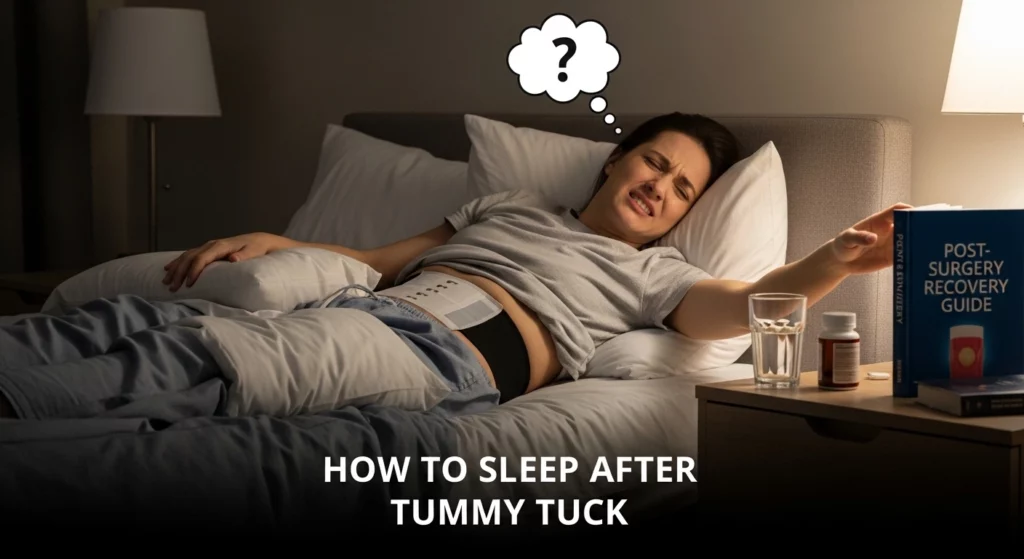
Patients frequently ask how to sleep after tummy tuck procedures because the physical sensation of lying down becomes suddenly unfamiliar and uncomfortable. Abdominoplasty permanently alters the physical tension across your core, making standard resting postures actively dangerous for your fresh incision site. Navigating this post-operative phase requires you to abandon your normal habits and adopt a highly specific, flexed posture that prioritizes tissue relaxation over immediate comfort. By engineering a supportive bed setup, you can enforce the correct healing angles, prevent localized swelling, and achieve the restorative rest your body needs to recover.
Anatomical Demands of Abdominoplasty Healing
During a tummy tuck, a surgeon removes excess skin and physically tightens the underlying abdominal musculature. This major structural repair creates a highly sensitive environment that requires zero physical tension to heal safely. Understanding the exact mechanical demands placed on your spine and core will dictate the tools you choose for your recovery.
Suture Tension and Muscle Repair
The primary rule of post-op sleep care is to keep your abdominal wall completely slack. If you lie flat on your back, your core muscles automatically stretch, which pulls directly against your fresh internal sutures and the external closure. This stretching action introduces a shearing force that can cause micro-tears in the healing tissue, leading to widened, highly visible scars.
Surgeons place surgical drains to remove excess inflammatory fluid from the cavity, and stretching the abdomen risks dislodging these tubes prematurely. You must physically shorten the distance between your ribcage and your pelvis while you rest to eliminate this mechanical strain. Achieving this requires raising your upper body and bending your knees, completely disengaging the abdominal muscles from the equation.
The Role of the Semi-Fowler’s Position
In a clinical setting, we refer to this required resting posture as the Semi-Fowler’s position. This medical stance requires you to elevate your torso at a 30 to 45-degree angle while simultaneously supporting your knees in a bent position. This specific geometric angle uses gravity to your advantage, keeping your airway clear while preventing fluid from pooling in the lower abdomen.
As Dr. Matthew Schulman, a board-certified plastic surgeon, notes, “Maintaining a strict Semi-Fowler’s position is non-negotiable in the first two weeks, as it drastically reduces the risk of seromas and completely removes the mechanical tension from the muscle plication.” A patient cannot achieve this rigid, unchanging angle by simply stacking soft feather cushions against a headboard. You must rely on dense, structured support blocks to hold your heavy torso in place securely overnight.
Engineering a Safe Post-Surgical Sleep Setup

Designing a safe space for your recovery involves selecting materials that will not fail or compress under your body weight. You must transition away from standard bedding and adopt clinical tools to maintain your required angles.
Torso Elevation and Fluid Dynamics
To properly elevate the upper body, you must use a dense, high-density memory foam system. When evaluating a wedge pillow vs regular pillow after tummy tuck, the rigid foam block is the only reliable choice for maintaining the 45-degree angle without collapsing. This rigid elevation promotes downward lymphatic drainage, continuously moving post-surgical edema away from your healing incision site. If your torso sinks backward during the night, your core will involuntarily tighten to catch your falling weight, causing acute spikes in morning pain.
Lower Extremity and Lumbar Support
Elevating your chest solves half of the mechanical equation, but you must also address the lower half of your body. Placing a secondary foam bolster directly under your knees allows your lower back to rest flat against the mattress. If your legs remain straight while your chest is raised, your lumbar spine will arch aggressively, leading to severe paraspinal muscle spasms. This secondary knee support locks your pelvis into a neutral tilt, completely releasing the tension from your lower back and lower abdomen.
Navigating Combined Procedures
Many patients combine their abdominal surgery with a Brazilian Butt Lift (BBL), which creates a highly complex set of postural restrictions. You cannot place weight on your abdomen, nor can you place weight on your newly grafted glutes, severely limiting your resting options.
Pressure Redistribution Challenges
Figuring out how to sleep after bbl and tummy tuck requires you to completely suspend your midsection and your glutes simultaneously. You cannot use a standard bed for this, as the mattress will inevitably press against one of your surgical sites. Patients undergoing these combined procedures must rent or purchase an inflatable BBL mattress featuring a specific cutout for the buttocks. Alternatively, you can utilize a zero-gravity recliner chair lined with very soft, pressure-relieving foam to keep the hips suspended.
Real-Time Clinical Example
A 34-year-old female patient presented with severe discomfort trying to figure out how to sleep after tummy tuck and bbl procedures. She was attempting to sleep on her side to avoid pressure, which caused her abdominal incision to fold and weep fluid. I immediately transitioned her into a rented zero-gravity mechanical chair with a specialized Boppy pillow placed exclusively under her lower thighs. This allowed her glutes to hover freely while maintaining the necessary 45-degree torso elevation for her abdomen, resulting in a full, uninterrupted night of sleep.
The Transitional Timeline to Normalcy
Your sleeping arrangements will evolve as your internal tissues scar down and gain mechanical strength. You must follow a gradual progression to return to your preferred resting postures safely.
Easing Off the Incline
Around the three-week mark, most surgeons will allow you to decrease the angle of your torso elevation. You can transition from the steep 45-degree block to a much lower 15-degree incline. You should listen closely to your body during this phase, as any sharp pulling or burning sensations indicate that you need to raise the angle back up immediately. You must continue to keep a pillow under your knees during this transitional phase to protect your lower back from taking on the new physical stress.
Returning to the Prone Position
For natural stomach sleepers, the hardest part of this recovery is waiting for clearance to roll back over. It generally takes a minimum of six to eight weeks before a surgeon will clear you to place direct pressure on the abdominal wall. Once you are cleared, you must support your cervical spine correctly to prevent trading abdominal comfort for neck pain. Upgrading to the best pillow for tummy sleepers will allow your head to rest low to the mattress, ensuring your spine stays neutral while you finally enjoy sleeping on your stomach again.
Frequently Asked Questions
How long after tummy tuck can I lay flat?
Most patients are required to avoid lying flat for a minimum of two to three weeks following surgery. Your specific timeline depends entirely on how quickly your internal muscle repair heals and stabilizes. You must wait until your plastic surgeon formally evaluates your incision and gives you explicit medical clearance to remove your elevated support blocks.
How long to sleep elevated after tummy tuck?
You will need to maintain a strict, elevated Semi-Fowler’s position for at least fourteen days. After this initial window, you can slowly begin to lower the angle of your wedge pillow over the next several weeks. Many patients choose to continue sleeping with a slight elevation for a full month to help combat lingering evening swelling.
How to sleep after bbl and tummy tuck?
Sleeping after these combined procedures requires you to avoid putting pressure on both your stomach and your buttocks. You will need to use an inflatable recovery mattress with a designated glute hole, or sleep in a zero-gravity recliner. You must ensure your thighs bear the weight of your lower body so your grafted fat cells remain untouched and viable.
How long is bed rest after tummy tuck?
Strict bed rest is highly discouraged after major abdominal surgery because it increases the risk of developing deep vein thrombosis or blood clots. While you will spend the majority of your time resting in an elevated position, your surgeon will require you to stand up and walk around your house for a few minutes every couple of hours. This light, immediate movement promotes necessary blood circulation and speeds up the healing timeline.
How long after abdominoplasty can I sleep on my side?
Side sleeping places asymmetrical pressure on the abdominal wall, which can warp the healing of your internal muscle tightening. You generally cannot roll onto your side until four to six weeks post-operation. Even then, you should place a thick supportive pillow between your knees and gently hug another pillow against your chest to keep your spine from twisting.
How to sleep after panniculectomy?
A panniculectomy involves removing the overhanging apron of skin and fat, often without the underlying muscle repair seen in a full tummy tuck. Despite the lack of muscle tightening, you still have a massive horizontal incision that requires identical tension relief. You must sleep on your back with your head elevated and your knees supported by a foam wedge for at least three weeks to prevent the heavy incision from separating.
How to sleep in bed after tummy tuck without a recliner?
If you do not own a mechanical recliner, you must build a rigid support system directly on top of your mattress. You will need a multi-piece orthopedic foam wedge set to lock your upper body at a 45-degree angle and a secondary foam bolster to place under your knees. You should avoid trying to stack standard bedroom pillows, as they will compress during the night and allow your torso to fall flat.
Final Takeaways
Learning how to sleep properly after major abdominal surgery dictates the quality and speed of your recovery. You must prioritize sleeping on your back with your torso elevated and your knees bent to remove all mechanical tension from your healing incision. Specialized foam wedge blocks offer the rigid, reliable support required to hold your body in the Semi-Fowler’s position overnight safely. By respecting your body’s structural limits and following a gradual timeline to return to lying flat, you can effectively manage post-operative pain and secure the best possible aesthetic result.
References
- Schulman, M. (2024). Post-Operative Guidelines for Abdominoplasty. American Society of Plastic Surgeons.
- Adams, J. (2025). Managing Edema and Swelling After Core Surgery. Journal of Aesthetic Nursing.
- Plastic and Reconstructive Surgery Journal (2023). The impact of sleep positioning on incision healing and scar widening.
- National Board of Medical Examiners. (2024). Post-op protocol and incision care standards.
- Can a Wedge Pillow Help With Tummy Tuck Recovery? - February 24, 2026
- How Firm Should a Pillow Be for Stomach Sleepers - February 24, 2026
- When to Stop Using a Tummy Time Pillow - February 24, 2026