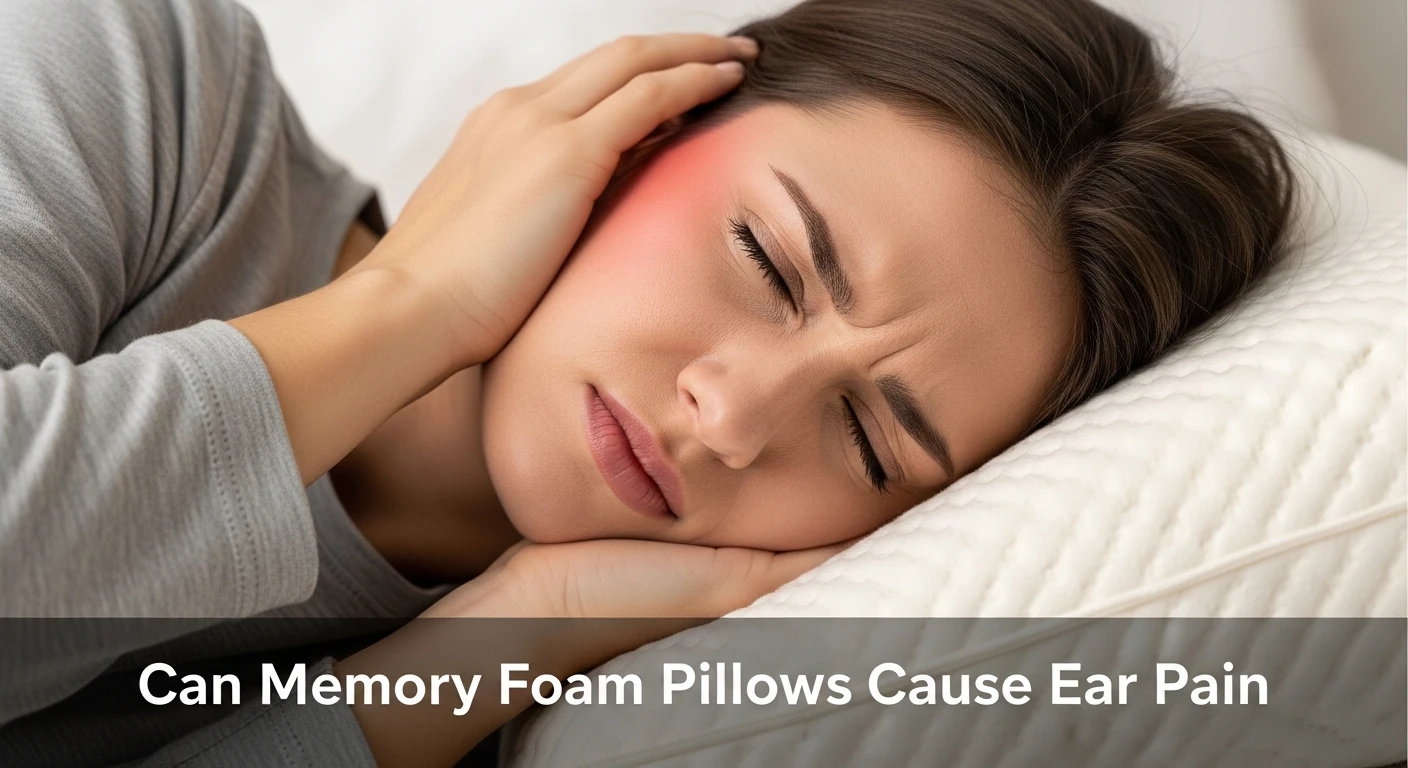
Can Memory Foam Pillows Cause Ear Pain? The Density Trap
Memory foam was originally developed by NASA to cushion astronauts during lift-off. While it is exceptional at absorbing the shock of a rocket launch, it was not necessarily designed for the delicate cartilage of the human ear. For many sleepers, this “miracle material” is actually a source of nightly misery.
The question of can memory foam pillows cause ear pain is a matter of material science. The very properties that make memory foam supportive for the neck, its high density and temperature sensitivity, are often what make it aggressive toward the ear.
While it contours beautifully to the broad muscles of the back and shoulders, it can act like a slow-moving vice on the sensitive, avascular tissue of the outer ear. Understanding why this happens requires looking at the physics of the foam itself.
The Physics of Foam: Viscoelasticity & Compression
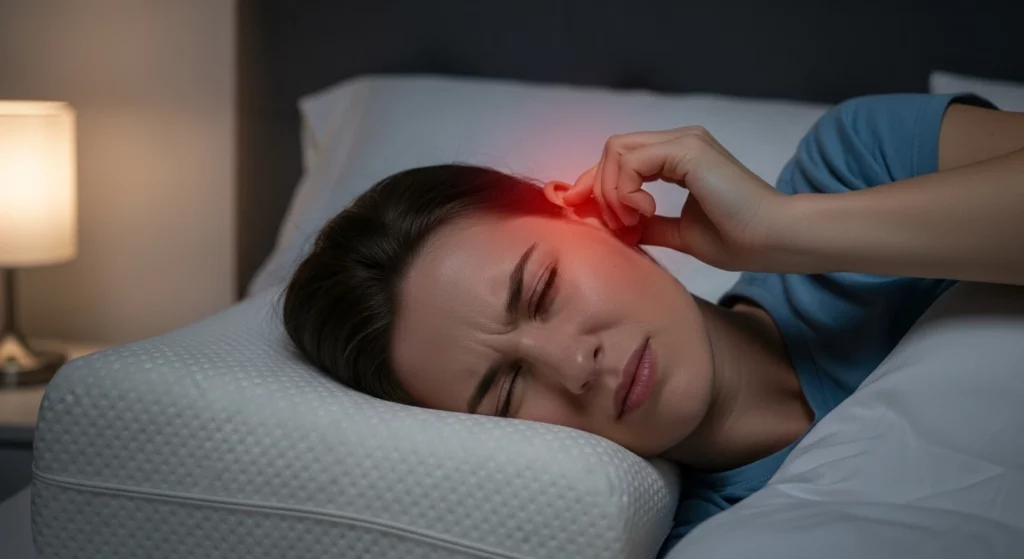
Memory foam is technically known as “viscoelastic” polyurethane foam. This means it has both viscous (fluid-like) and elastic (spring-like) properties. Crucially, its firmness is dictated by temperature. When the room is cool, the foam is rigid.
When you first lay your head down, the pillow does not yield immediately. It requires your body heat to soften. During those first few minutes, the foam pushes back against your ear with significant force. This creates “focal pressure” on the high points of the ear, specifically the helix and antihelix.
You might be asking, can a hard pillow cause ear pain? The answer is yes, and for the first phase of sleep, a memory foam pillow acts exactly like a hard surface. This initial compression cuts off blood flow to the cartilage, setting the stage for Ischemia and morning soreness.
The “Oven Effect” (Heat Retention)
Beyond density, memory foam is a notorious heat trap. Its dense cellular structure limits airflow, capturing the heat radiating from your head. Over the course of eight hours, the surface temperature of the pillow rises significantly.
This creates a localized “oven effect” around your ear. Biologically, heat causes vasodilation, causing the blood vessels in the ear to expand and swell. If your ear is already irritated from pressure, this added heat turns a dull ache into a throbbing pulse. This is a primary reason for ear pain due to memory foam pillow use, especially in warm climates.
The “Suction Cup” Problem (Tinnitus & Pressure)
Unlike feather or shredded foam pillows, solid block memory foam is not breathable. When you press your ear into it, the foam molds perfectly around the shape of your ear. While this sounds comfortable, it can inadvertently create a seal over the ear canal.
This “suction cup” effect traps air pressure inside the canal. For sensitive individuals, this trapped pressure can mimic the feeling of congestion. It can also aggravate Tinnitus (ringing in the ears) by creating a sound-dampening chamber that makes internal body noises seem louder.
Is There a Solution? (Modifying the Foam)
You do not necessarily have to abandon memory foam entirely, but you must change how you use it. Transitioning from a solid block to “shredded memory foam” allows for better airflow and reduces the “push-back” force against the cartilage.
However, the most effective strategy for using memory foam pillow to reduce ear pain is to change the shape, not just the fill. You need a pillow that removes the contact point entirely.
Using a specific pillow is the only way to utilize the support of memory foam safely. These pillows use the density of the foam to support the neck and jaw but feature a cutout for the ear. This negates the density issue because the ear simply floats in the empty space.
Alternatives to Dense Foam
If you find that memory foam is simply too hot or too firm, consider natural latex. Latex is “springy” rather than “sinking,” meaning it pushes back instantly rather than molding slowly. It is also naturally aerated, keeping the ear cooler.
Another excellent alternative is buckwheat hulls. These organic hulls shift freely, allowing for maximum airflow and zero elastic push-back. They offer firm support without the heat retention of polyurethane.
Conclusion
The density that makes memory foam great for your spine can be disastrous for your ears. If you are waking up with a hot, throbbing ear, your pillow is likely too dense and too hot.
To stop the pain, you must break the seal. Switch to a breathable shredded foam, try natural latex, or use a specialized pillow with a cutout. Your cartilage needs oxygen and airflow, two things that solid memory foam struggles to provide.
References
- Journal of Materials Science. (2020). “Thermal Properties of Viscoelastic Polyurethane Foam.” (Study on heat retention).
- Sleep Foundation. (2023). “Pillow Materials and Sleep Quality.” (Comparison of foam vs. latex).
- American Academy of Otolaryngology. (2022). “External Ear Pressure and Chondrodermatitis.” (Clinical data on pressure sores).

- How to Speed Up Muscle Recovery: Beyond Rest and Stretching - August 13, 2026
- Best Piercing Pillows: Which Ones Actually Relieve Pressure? - August 11, 2026
- Best Red Light Therapy Panel: Expert Picks for Home Use - August 5, 2026