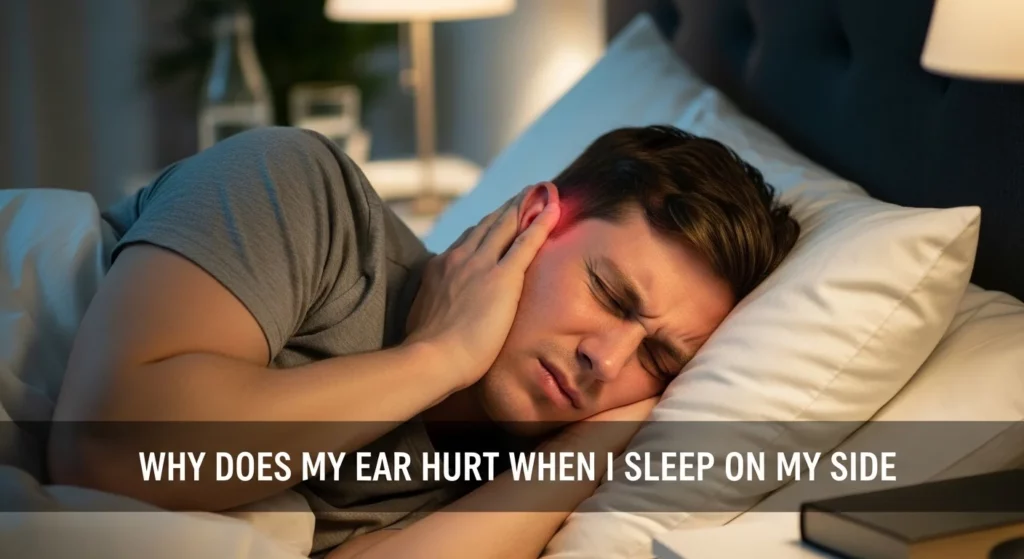
You wake up and roll over. A sharp, throbbing pain shoots through your ear. It feels tender to the touch. It might even be red and warm.
This morning agony is common. It disrupts your sleep quality and leaves you starting the day in pain.
You are likely asking yourself, “Why does my ear hurt when I sleep on my side?“
The answer is rarely an infection. It is usually physics.
It is often a case of “mechanical compression.” Your head is heavy. Your pillow is firm. Your ear is getting crushed between them.
This restricts blood flow and irritates the nerves. The good news is that you can fix it. You just need to understand what is happening to your anatomy.
The Anatomy of “Pillow Ear”: Why Pressure Causes Pain
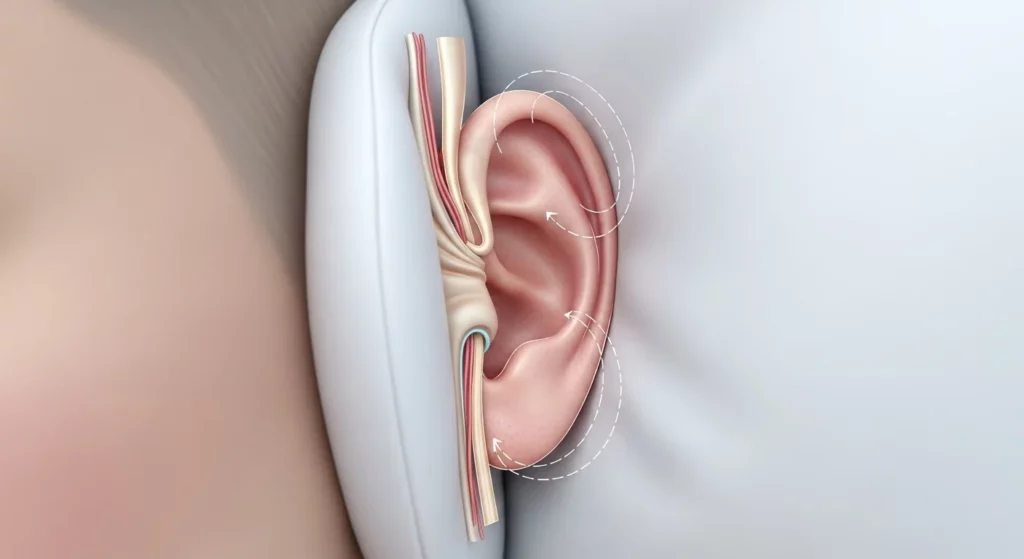
Your outer ear is called the pinna or auricle. It is made almost entirely of cartilage and skin.
Unlike your buttocks or your back, your ear has very little fat padding. There is no cushion to absorb pressure.
When you lie on your side, the full weight of your head presses down on this delicate structure. The average human head weighs between 10 and 11 pounds.
That is like resting a bowling ball on your ear all night.
This pressure compresses the blood vessels in the skin and auricular cartilage. This condition is called Ischemia. It means blood flow is restricted.
You might not feel the pain while you are asleep. The pain often hits when you wake up and lift your head.
Gravity allows the blood to rush back into the tissue. This process is called “reperfusion.” It causes the nerve endings to fire rapidly. That is why you wake up with ear pain that throbs but fades after 15 to 30 minutes.
4 Common Culprits Behind the Pain
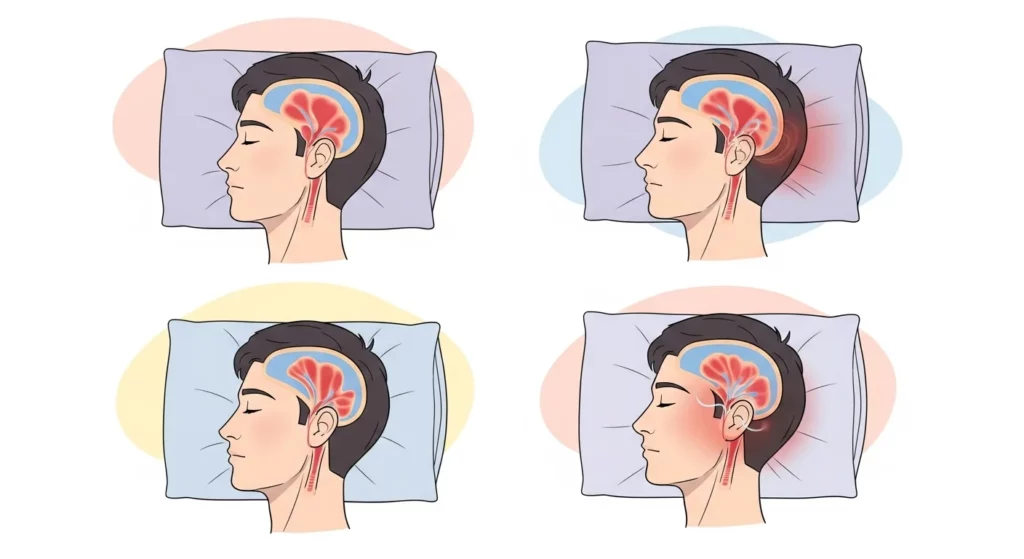
If you experience sore ear cartilage after sleeping, one of these four factors is likely to blame.
1. The Wrong Pillow Surface
Your pillow is the most common offender.
If your pillow is too firm, it acts like concrete. It creates a direct pressure point on the helix (the curved rim) or the antihelix (the inner ridge).
If your pillow is too soft, your head sinks in too deep. This causes the ear to fold over or crumple. This folding puts immense strain on the cartilage.
2. CNH (Chondrodermatitis Nodularis Helicis)
This is a specific medical condition. CNH is a painful, inflammatory nodule that forms on the ear.
It is literally a pressure sore. It is most common in men over 50 but can happen to anyone.
It feels like a tiny, extremely sensitive bump on the rim of the ear. The pain is often sharp and stabbing. It is caused directly by chronic mechanical compression from sleeping on the same side every night.
3. TMJ & Referred Pain
Sometimes the pain isn’t in your ear at all.
Your jaw joint (temporomandibular joint) sits right next to your ear canal. If you grind your teeth or clench your jaw at night, that tension radiates.
This is called Referred Pain. You feel it in your ear, but the source is your jaw.
4. Unresolved Inflammation
Do you have cartilage piercings? Even healed piercings can become tender under pressure.
The jewelry presses into the skin. This can cause localized inflammation.
If you have a history of “swimmer’s ear” or skin conditions like eczema, your ear skin may be more sensitive to friction.
How to Stop Ear Pain From Side Sleeping (Clinical Solutions)
You do not have to force yourself to sleep on your back. You can fix this with simple ergonomic changes.
The “Off-Loading” Strategy
The most effective clinical solution is simple. You must physically remove the contact between your ear and the bed.
Doctors call this “off-loading.”
If you can keep the weight of your head supported while letting the ear float, the pain stops. This prevents Ischemia. It allows CNH sores to heal.
I strongly recommend using a specialized pillow for ear pain. These pillows feature a dedicated “ear pocket” or hole. They suspend your ear in the air while still supporting your head.
Correcting Cervical Alignment
Your neck position matters.
If your pillow is too low, your head tilts down. If it is too high, your head tilts up.
Both positions twist the cervical spine. This torque can increase the pressure on the side of your face and ear.
You want a neutral spine. Your nose should be parallel to the ground. This distributes the weight of your head evenly across your cheek and jaw, rather than focusing it all on the ear.
Heat/Cold Therapy
If you wake up with ear pain that is intense, manage it immediately.
Use a cold compress for the first 10 minutes. This reduces morning inflammation.
Follow it with a warm towel. This encourages blood flow to return to the cartilage gently.
When to See a Doctor
Most morning ear pain is mechanical. It is not dangerous.
However, you should watch for these red flags:
- Fluid Drainage: Any pus or liquid coming from the ear.
- Fever: This suggests an infection like Otitis Media.
- Hearing Loss: Muffled hearing that does not clear up.
- Swelling: If the ear is visibly swollen and hot to the touch.
If you notice these, see a healthcare professional. It may be an infection that requires antibiotics.
Conclusion
Ear pain when sleeping on side positions is frustrating. But it is solvable.
You are dealing with a simple mechanical problem. Your ear is under too much pressure.
Check your pillow firmness. Pay attention to your neck alignment. Consider an off-loading pillow to protect that sensitive cartilage.
You deserve to wake up feeling rested, not sore.
References
- Winkler, M. (1915). Chondrodermatitis nodularis chronica helicis. Arch. Dermatol. Syph., 121, 278-285. (Original description of pressure sores on the ear).
- O’Reilly, K., McDonnell, J. M., Ibrahim, S., Butler, J. S., Martin-Smith, J. D., O’Sullivan, J. B., & Dolan, R. T. (2024). Biomechanical and ergonomic risks associated with cervical musculoskeletal dysfunction amongst surgeons: A systematic review. The Surgeon, 22(3), 143-149.

- Can a Wedge Pillow Help With Tummy Tuck Recovery? - February 24, 2026
- How Firm Should a Pillow Be for Stomach Sleepers - February 24, 2026
- When to Stop Using a Tummy Time Pillow - February 24, 2026