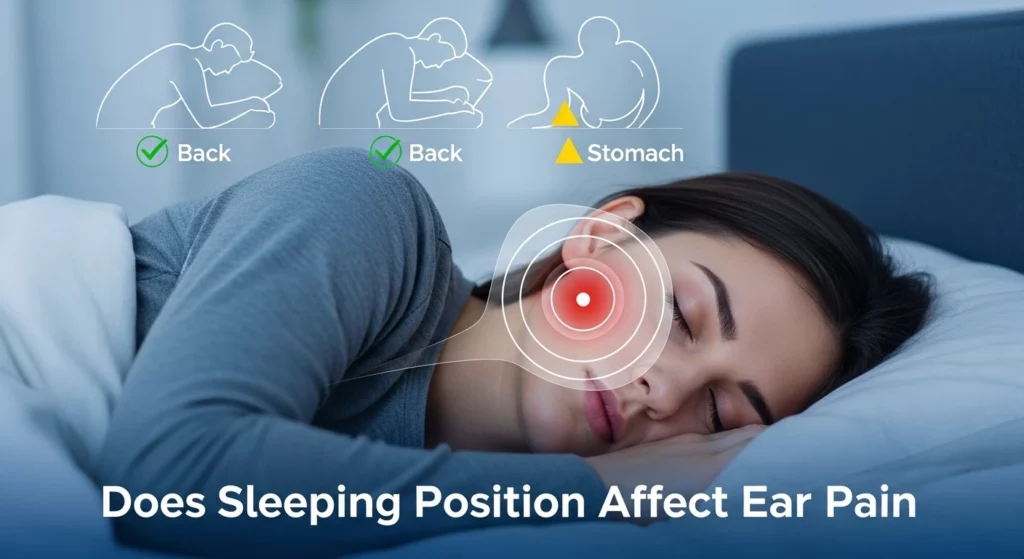
The human ear is an architectural marvel designed for capturing sound waves, but it is structurally terrible at supporting weight. Unlike the heel of your foot or the muscles of your back, the ear is an exposed appendage made of sensitive, avascular cartilage. When you use this delicate structure as a kickstand for your heavy skull, problems inevitably arise.
From a clinical perspective, the answer to does sleeping position affect ear pain is a definitive yes. Your posture during sleep dictates three critical factors: the amount of direct mechanical pressure on the tissue, the ability of fluid to drain from the inner ear, and the alignment of the jaw and neck. Ignoring these factors often leads to chronic morning soreness or aggravated infections.
Understanding the biomechanics of how you lie down is the first step toward correcting the issue. By analyzing the forces at play in side, back, and stomach sleeping, we can identify which habits are harming your hearing health.
The Biomechanics of Side Sleeping
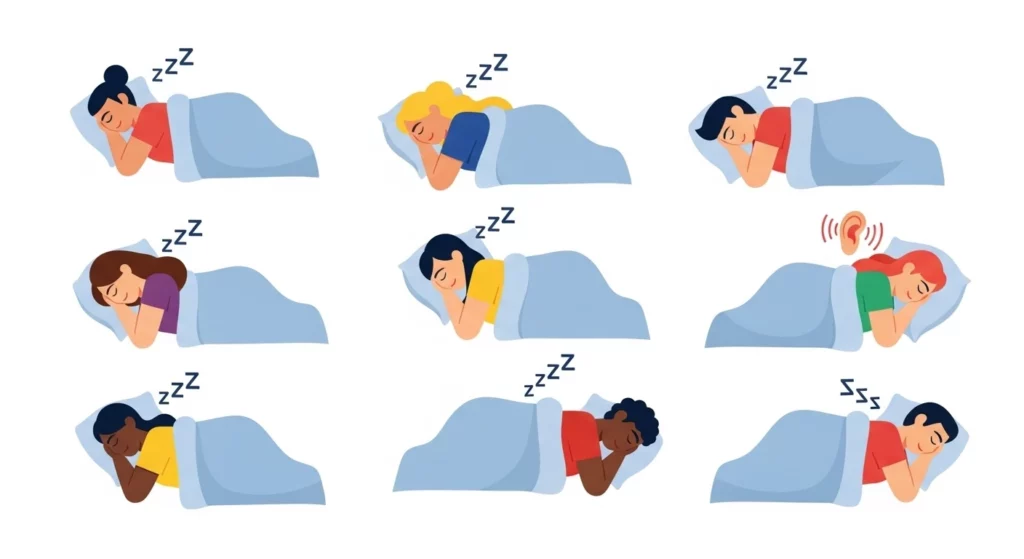
Side sleeping is the most popular sleep position, but it poses the highest risk for ear pain due to sleeping position. When you lie on your side, the full weight of your cranium (approximately 10 to 12 pounds) is transferred directly onto the Auricle, the outer part of the ear.
This crushing force compresses the tiny capillaries in the skin and cartilage. Since ear cartilage relies on diffusion from the skin for its oxygen supply, this compression creates a state of Ischemia, or oxygen starvation. The tissue effectively suffocates for hours at a time, leading to that sharp, burning sensation you feel upon waking.
Furthermore, this position creates a “seal” against the pillow that traps heat and moisture. For individuals prone to ear infections or impacted earwax, this warm, humid environment encourages bacterial growth and inflammation.
Stomach Sleeping: The Worst Offender
While side sleeping compresses the ear, stomach sleeping twists the support structures that connect to it. To sleep on your stomach and still breathe, you must rotate your cervical spine roughly 90 degrees to the side.
This extreme rotation places immense torque on the C1 and C2 vertebrae and the muscles of the jaw. This tension travels directly into the Temporomandibular Joint (TMJ), which sits millimeters from the ear canal. The resulting inflammation often radiates into the ear, feeling like a deep ache even though the ear itself was not touched.
Back Sleeping: The Neutral Zone
For patients suffering from chronic ear pain, back sleeping is the anatomical ideal. In this position, the ears are completely free from contact pressure, eliminating the risk of mechanical compression or Ischemia.
Additionally, back sleeping places the Eustachian tubes in a neutral position relative to gravity. As long as the pillow is not too high, fluid can drain naturally down the throat rather than pooling in the middle ear. This makes it the preferred posture for managing congestion or infection recovery.
Modifying Your Position for Relief
Changing your sleep habits is notoriously difficult because your body seeks familiarity. If you are a dedicated side sleeper, forcing yourself onto your back often results in poor sleep quality. A better approach is usually to modify your existing position to make it safer.
If you must sleep on your side, you need to eliminate the contact stress. The most effective clinical intervention is using an ear pillow. These devices act as a suspension system, supporting the skull while providing a cutout space for the ear to rest without touching any surface.
For those currently experiencing an acute flare-up, simply changing the surface is not enough; you must also address the inflammation. I recommend following a strict protocol on how to relieve ear pain while sleeping, which involves combining positional changes with thermal therapy and elevation.
The “Fluid Factor” (Congestion)
The angle of your head is just as important as the side you choose. Lying perfectly flat increases hydrostatic pressure in the head, which can cause fluid to become trapped in the inner ear.
If you are dealing with fluid buildup or congestion, reducing ear pain with sleeping position requires elevation. Propping your head up with a wedge pillow allows gravity to assist the lymphatic system and Eustachian tubes in clearing the blockage.
Conclusion
Your sleep position is a “silent contributor” to ear health. While back sleeping offers the least resistance, it is not the only option.
Avoid the neck-twisting torque of stomach sleeping. If you sleep on your side, acknowledge the mechanical load you are placing on your ear and take steps to off-load that pressure. By respecting the anatomy of the ear, you can protect it from unnecessary strain.
References
- Journal of Cutaneous Medicine and Surgery. (2019). “Chondrodermatitis Nodularis Helicis: A Review of Pressure-Induced Ear Pain.” (Analysis of mechanical compression).
- Sleep Health Foundation. (2023). “Sleep Posture and Orthopedic Pain.” (Discussion of cervical spine torque).
- American Journal of Otolaryngology. (2021). “Positional Therapy for Eustachian Tube Dysfunction.” (Study on gravity and fluid drainage).

- How to Use a Tummy Time Pillow Safely? - February 20, 2026
- Tummy Sleeper vs Side Sleeper Pillow: Which One Suits Whom? - February 20, 2026
- How to Choose the Best Pillow for Tummy Sleepers? - February 20, 2026