How to Sleep on Side Without Hurting Ear?
You are exhausted. You just want to sleep. But the moment your head hits the pillow, your ear starts to throb.
It is a cruel paradox. You need sleep to heal. But the act of sleeping hurts.
Many patients ask me how to sleep on side without hurting ear structures. They assume they have to force themselves to sleep on their back.
This is rarely successful. If you are a lifelong side sleeper, changing your position overnight is nearly impossible.
The good news is that you don’t have to change your habits. You just need to manage two things: gravity and pressure.
The Golden Rule: Elevation & Gravity
The first step to sleeping comfortably with ear pain is to understand the mechanics of why your ear hurts when sleeping on your side.
It often comes down to fluid dynamics. Your middle ear connects to your throat via the Eustachian tube. This tube drains fluid and equalizes pressure.
When you lie completely flat, gravity stops working in your favor. Fluid can pool in the middle ear. This increases pressure and causes that deep, throbbing ache.
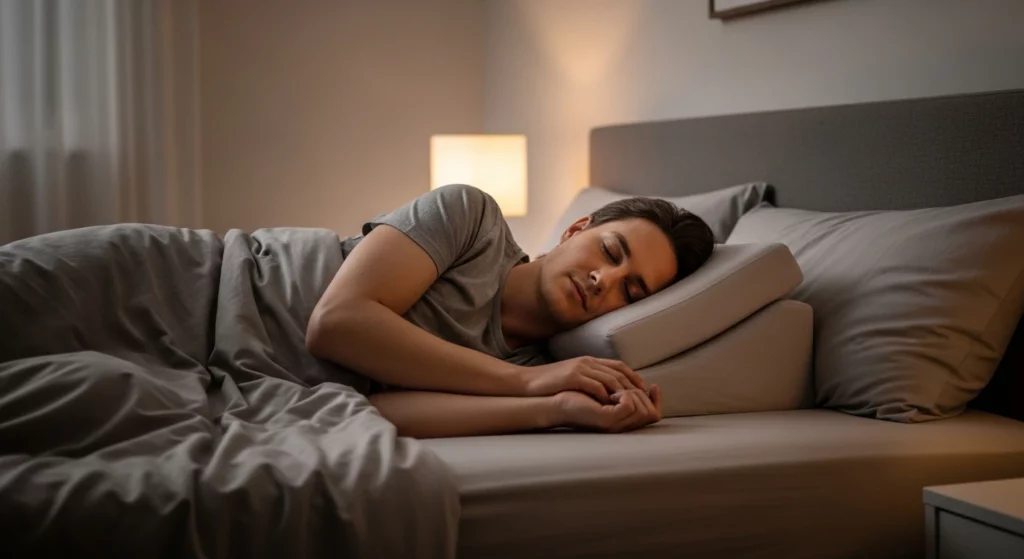
To fix this, you need to prop up your head. Use a wedge pillow or stack two standard pillows. The goal is to keep your ear above the level of your heart.
This slight elevation promotes fluid drainage. It prevents blood from rushing to the head too aggressively. It is the simplest way to reduce the intensity of the pain.
Strategy 1: Sleeping on the “Unaffected Side”
If you are dealing with a one-sided issue, like an ear infection or a fresh piercing, the solution is straightforward. You should sleep on the unaffected side.
This ear pain sleeping position accomplishes two things. First, it eliminates direct contact pressure. Your painful ear remains airborne. Nothing touches it.
Second, it assists drainage. With the bad ear facing the ceiling, gravity helps pull fluid out of the ear canal and Eustachian tube naturally. This is the most effective way to manage an active infection.
Strategy 2: Sleeping on the “Affected Side” (The Off-Loading Trick)
But what if both ears hurt? Or what if you physically cannot sleep on your other side? If you must sleep on the painful ear, you have to change the surface you are sleeping on.
You might be asking, can a hard pillow cause ear pain? The answer is yes. Even soft standard pillows push against the cartilage.
You need to use “mechanical off-loading.” This means creating a space where the ear can float.
Using an ear pillow for ear pain is the clinical gold standard for this. These pillows feature a dedicated hole in the center.
When you lay your head down, your skull is supported by the foam. But your ear rests in the empty space. This removes 100% of the mechanical pressure. It allows you to maintain your preferred side-sleeping posture without crushing your sensitive cartilage.
3 Ergonomic Tips for Sleeping Comfortably with Ear Pain
Beyond pillows and gravity, there are small adjustments that make a big difference.
Reduce Neck Torque
Your ear pain might actually be jaw pain. If your pillow is too low or too high, your neck twists. This torque tightens the Temporomandibular Joint (TMJ).
The TMJ sits directly next to the ear canal. Tension here often feels like deep ear pain. Keep your nose aligned with your sternum. A neutral neck relaxes the jaw and can instantly relieve pressure in the ear.
The “Soft Surface” Audit
Friction is an enemy. If you do not have an ear pillow, check your pillowcase. Rough cotton or linen can act like sandpaper on inflamed skin.
Switch to a silk or bamboo pillowcase. These materials are frictionless. They allow your skin to glide rather than drag. This reduces surface irritation on the outer ear.
Warm Compress Before Bed
If you struggle with how to sleep with ear pain caused by tension, try heat. Apply a warm, damp cloth to the area around the ear (not directly on it) for 10 minutes before bed.
Heat dilates blood vessels. It relaxes the muscles around the ear and jaw. This prevents the “clamping” sensation that often keeps people awake.
When is it an Infection?
It is important to know the difference between mechanical pain and infection. Mechanical pain (from pressure) usually stops hurting 30 minutes after you wake up.
An ear infection is different. It often comes with a fever. You may see fluid draining from the ear. The pain is constant, not just when you touch it.
If you suspect an infection, how to sleep with ear infection pain becomes a medical question. You still need elevation and off-loading. But you also need antibiotics. See a doctor if the pain persists during the day.
Conclusion
You do not have to suffer through the night. If you are wondering how to sleep on side without hurting ear tissue, remember the formula.
Elevate your head to drain fluid. Off-load the pressure with a specialized pillow. Align your neck to relax the jaw.
With these three steps, you can get the rest you need to heal.
References
- Tasker, A., et al. (2020). “Postural effects on Eustachian tube function.” Otolaryngology–Head and Neck Surgery. (Study on gravity and drainage).
- Choi, J.H., et al. (2021). “The influence of sleep position on the ear: A biomechanical analysis.” Journal of Sleep Research. (Analysis of pressure distribution in side sleeping).
- American Academy of Otolaryngology. (2023). “Managing Ear Pain at Night.” (Clinical guidelines for elevation and heat therapy).

- Best Lumbar Support Pillows: Which Ones Really Help? - October 14, 2026
- Best Heating Pads for Back Pain: Electric, Cordless, or Microwavable? - October 9, 2026
- How Do Air Purifiers Work? Inside the Filtration Process - October 9, 2026