Peptide stacking—the strategic combination of multiple peptides to achieve synergistic or complementary effects—has become an area of intense interest in research and therapeutic applications. While individual peptides offer targeted benefits, combining peptides with different mechanisms can potentially amplify results, address multiple pathways simultaneously, and optimize outcomes. This comprehensive guide explores the principles of peptide stacking, common combinations, safety considerations, and best practices for implementing multi-peptide protocols.
Understanding Synergy and Complementary Effects
Before exploring specific combinations, it’s important to understand the concepts underlying effective peptide stacking.
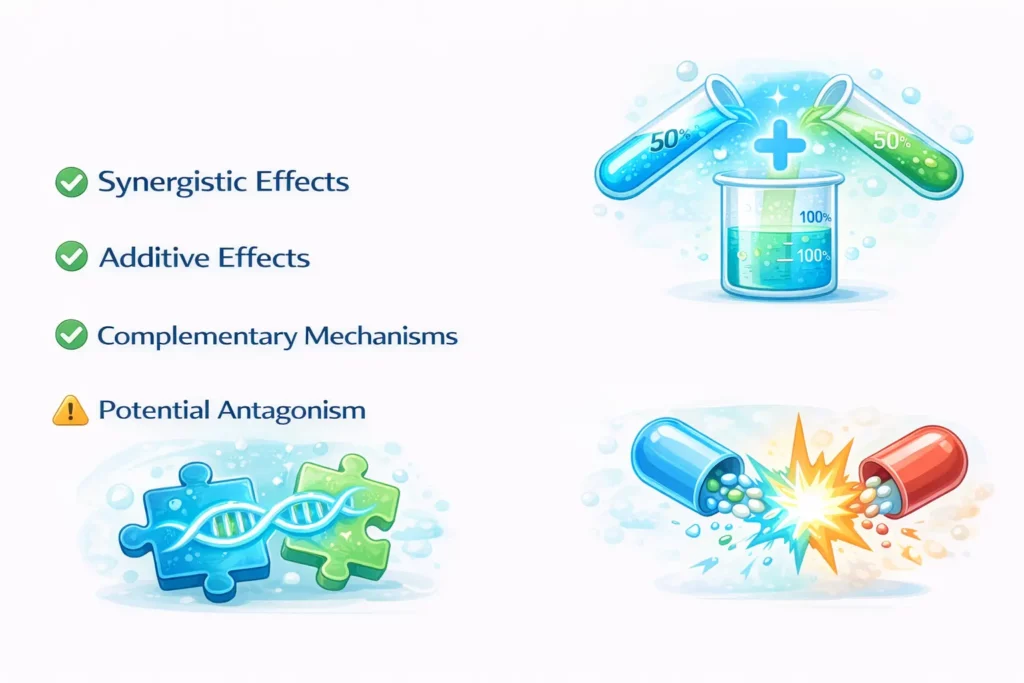
Synergistic Effects
True synergy occurs when the combined effect of two peptides exceeds the sum of their individual effects. For example, if Peptide A produces a 20% improvement and Peptide B produces a 15% improvement, a synergistic combination might produce a 50% improvement rather than the expected 35%.
Synergy typically arises when peptides act on different points in the same pathway, amplifying signal transmission, work through complementary mechanisms that enhance each other’s effects, or remove limiting factors that restrict the other peptide’s efficacy.
Additive Effects
More commonly, peptides produce additive effects where the total benefit equals the sum of individual contributions. While less dramatic than synergy, additive effects still justify combining peptides when targeting multiple aspects of a condition or goal.
Complementary Mechanisms
Even without direct synergy, combining peptides with different mechanisms can provide comprehensive benefits. For instance, one peptide might enhance tissue regeneration while another reduces inflammation, together addressing different aspects of injury recovery.
Potential Antagonism
It’s also possible for peptides to interfere with each other, producing antagonistic effects where the combination is less effective than individual peptides. Understanding mechanisms helps predict and avoid such combinations.
Principles of Effective Peptide Stacking
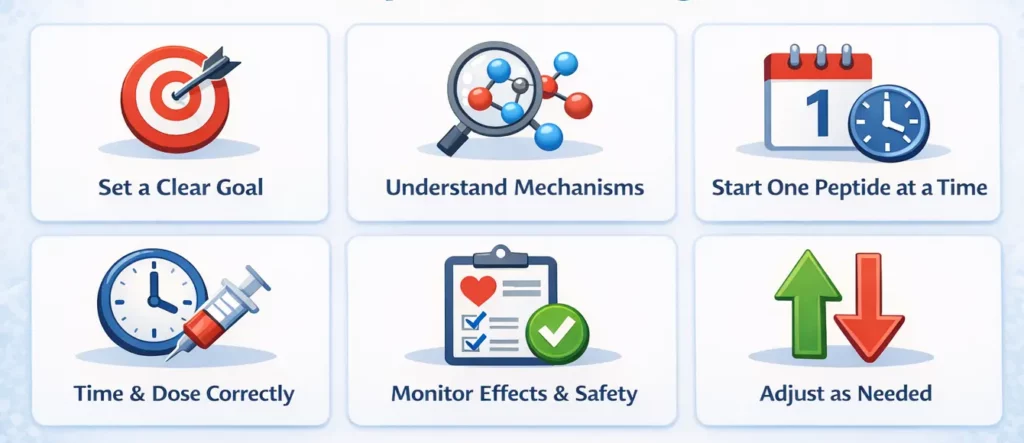
Successful peptide stacking follows several fundamental principles:
Mechanistic Understanding
Effective stacking requires understanding how each peptide works. Combining peptides without knowledge of their mechanisms is essentially guesswork. Research each peptide’s:
- Primary mechanism of action
- Receptor targets and signaling pathways
- Tissue distribution and cellular effects
- Metabolic pathways and clearance
- Potential interactions with other compounds
This knowledge helps predict whether peptides will work synergistically, additively, or antagonistically.
Clear Objectives
Define specific goals for the stack. Are you targeting multiple symptoms of one condition? Addressing different aspects of performance or recovery? Supporting complementary processes? Clear objectives guide peptide selection and help evaluate outcomes.
Progressive Implementation
Rather than starting all peptides simultaneously, implement stacks progressively:
- Establish baseline measurements
- Introduce first peptide, assess effects and tolerance
- Add second peptide after the first is well-tolerated
- Continue sequentially if using three or more peptides
- Evaluate combined effects against baseline
This approach helps identify which peptides contribute specific benefits and makes troubleshooting side effects easier.
Appropriate Dosing:
Stacking peptides doesn’t necessarily require maximum doses of each compound. In fact, synergistic combinations may allow lower individual doses while maintaining or enhancing benefits. Consider:
- Starting with lower doses of each peptide
- Adjusting based on response and tolerance
- Recognizing that “more is better” doesn’t always apply
- Balancing efficacy with side effect profiles
Monitoring and Adjustment
Successful stacking requires ongoing assessment:
- Track relevant biomarkers and outcomes
- Monitor for side effects or unexpected responses
- Adjust dosing, timing, or combinations based on results
- Be prepared to remove peptides that don’t contribute or cause problems
Growth Hormone and IGF-1 Related Stacks
One of the most researched areas of peptide stacking involves growth hormone (GH) and insulin-like growth factor-1 (IGF-1) pathways, relevant for tissue growth, recovery, and body composition.
Growth Hormone Secretagogues
Peptides that stimulate GH release include CJC-1295 (with or without DAC), ipamorelin, GHRP-2, GHRP-6, hexarelin, and others. These work by mimicking ghrelin or stimulating the pituitary to release GH.
Common GH-Related Stacks
CJC-1295 + Ipamorelin
This is among the most popular GH secretagogue stacks. CJC-1295 (particularly the DAC version) provides sustained GH elevation due to its extended half-life. Ipamorelin stimulates pulsatile GH release with minimal effect on cortisol or prolactin. Together, they may provide both sustained elevation and periodic pulses mimicking natural GH patterns.
Potential benefits include enhanced muscle growth and recovery, improved fat metabolism, better sleep quality, increased collagen synthesis supporting joint and skin health, and potential anti-aging effects.
Typical protocols involve dosing ipamorelin 2-3 times daily (often pre-workout and before bed) and CJC-1295 (with DAC) once or twice weekly due to its long half-life, or CJC-1295 (no DAC) dosed with each ipamorelin administration.
GHRP-6 + Mod GRF (1-29)
GHRP-6 strongly stimulates GH release while also increasing appetite (potentially beneficial or problematic depending on goals). Modified GRF (1-29), also called CJC-1295 without DAC, amplifies GH response when combined with GHRP compounds. This combination produces substantial GH pulses when dosed together, typically 2-3 times daily.
IGF-1 and GH Combinations
Some protocols combine GH secretagogues with IGF-1 variants like IGF-1 LR3 (long R3 IGF-1), which has extended half-life and reduced binding to IGF binding proteins. The rationale is that increasing both GH (which stimulates endogenous IGF-1 production) and providing exogenous IGF-1 might enhance anabolic effects.
However, this combination requires careful consideration as it substantially elevates growth factor signaling, potentially increasing risks. Close monitoring of glucose metabolism, potential organ effects, and other safety parameters is essential.
Metabolic and Body Composition Stacks
Peptides targeting metabolism, fat loss, and body composition are frequently combined.
GLP-1 and Related Combinations
GLP-1 agonists like semaglutide or liraglutide potently reduce appetite and support weight loss. Stacking considerations include:
GLP-1 + Growth Hormone Secretagogues
Combining appetite suppression and metabolic benefits of GLP-1 with the muscle-preserving and recovery-enhancing effects of GH secretagogues might optimize body composition during weight loss. The GH component may help preserve lean mass while GLP-1 facilitates fat loss.
However, both affect glucose metabolism (GLP-1 enhancing insulin secretion, GH potentially increasing insulin resistance), requiring monitoring of blood glucose and insulin sensitivity.
GLP-1 + Metabolic Peptides
Combining GLP-1 with peptides affecting mitochondrial function (like SS-31) or fat oxidation might enhance metabolic flexibility and energy expenditure alongside appetite reduction.
AOD-9604 + CJC-1295/Ipamorelin
AOD-9604, a modified fragment of growth hormone, reportedly promotes fat loss without affecting blood sugar or growth. Some stack this with GH secretagogues on the theory that AOD-9604 targets fat loss while GH secretagogues support muscle preservation and recovery.
Evidence for AOD-9604’s efficacy is limited compared to some other peptides, so expectations should be appropriately calibrated.
Recovery and Healing Stacks
Peptides promoting tissue repair, reducing inflammation, and accelerating recovery are commonly combined, particularly relevant for injury recovery or athletic applications.
BPC-157 + TB-500
This is perhaps the most popular recovery stack:
BPC-157 (Body Protection Compound-157)
Derived from a protective protein in gastric juice, BPC-157 shows tissue-healing properties in research, including promoting angiogenesis (blood vessel formation), protecting and healing gastrointestinal tissue, supporting tendon and ligament repair, and potentially reducing inflammation.
TB-500 (Thymosin Beta-4)
This peptide promotes cell migration, proliferation, and differentiation, supporting tissue regeneration, reducing inflammation, improving flexibility and recovery, and potentially preventing scar tissue formation.
Together, these peptides may work synergistically in healing, with BPC-157 promoting vascular development and TB-500 supporting cellular regeneration. Typical protocols involve daily dosing of both peptides, often at injury sites (for localized issues) or systemically (for general recovery).
Recovery Stack + Growth Factors
Some protocols add GH secretagogues to BPC-157/TB-500 combinations. The rationale is that GH and IGF-1 promote tissue growth and repair, complementing the specific healing mechanisms of BPC-157 and TB-500.
This three-way combination might benefit major injuries, surgical recovery, or situations requiring maximal healing support.
Anti-Inflammatory Combinations
Peptides with anti-inflammatory properties include:
KPV
This tripeptide (lysine-proline-valine) shows anti-inflammatory effects, particularly in the gut. Research suggests it may reduce inflammation by modulating inflammatory signaling pathways.
LL-37
An antimicrobial peptide that also possesses immunomodulatory properties, potentially supporting healing while controlling infection risk.
Combining anti-inflammatory peptides with tissue-healing compounds like BPC-157 addresses both inflammation and regeneration aspects of recovery.
Cognitive and Neuroprotective Stacks
Peptides affecting brain health, cognition, and neuroprotection are sometimes combined.
Nootropic Peptide Combinations
Peptides with cognitive effects include:
Semax
A synthetic peptide derived from ACTH that enhances learning, memory, and attention while potentially reducing anxiety. It may work through neurotransmitter modulation and neurotrophic effects.
Selank
Similar to Semax but with more pronounced anxiolytic (anti-anxiety) effects alongside cognitive enhancement.
Cerebrolysin
As discussed previously, this mixture of neurotrophic peptides supports neuronal health and function.
Some researchers and clinicians explore combining these peptides for comprehensive cognitive support, particularly in conditions involving cognitive impairment or neurological injury. However, evidence for such combinations is limited, and effects can be variable.
Neuroprotective Combinations
For neuroprotection, combining:
Cerebrolysin + NAD+ Precursors
While NAD+ precursors (nicotinamide riboside, NMN) are not strictly peptides, combining them with neuroprotective peptides like Cerebrolysin might support neuronal metabolism and function through complementary mechanisms.
Semax + BPC-157
Both peptides show neuroprotective properties in research. BPC-157 may support neurovascular healing while Semax enhances cognitive function and neuronal resilience.
Mitochondrial Support Stacks
Given mitochondrial dysfunction’s role in aging and disease, stacking mitochondrial-targeted interventions is an area of interest.
SS-31 + NAD+ Support
SS-31 directly targets mitochondrial cardiolipin, stabilizing mitochondrial membranes and improving function. Combining this with NAD+ precursors (which support mitochondrial NAD+ levels, crucial for energy production) might synergistically enhance mitochondrial health.
SS-31 + Antioxidants
While SS-31 itself reduces oxidative stress at the source, combining it with specific antioxidants (like MitoQ, which also targets mitochondria, or systemic antioxidants) might provide comprehensive oxidative stress management.
Mitochondrial Peptides + Metabolic Support
Combining mitochondrial-targeted peptides with metabolic optimizers (alpha-lipoic acid, carnitine, CoQ10) might enhance overall cellular energy production and metabolic health.
Sexual Health and Hormone-Related Stacks
Peptides affecting sexual function and hormonal balance are sometimes combined.
PT-141 + PDE5 Inhibitors
While PT-141 works centrally to enhance desire and arousal, PDE5 inhibitors (Viagra, Cialis) work peripherally to support erectile function. Combining these addresses different aspects of sexual function:
- PT-141 enhances libido and arousal through CNS effects
- PDE5 inhibitors facilitate physical erectile response
This combination might benefit individuals with both desire and erectile components to sexual dysfunction. However, careful attention to cardiovascular effects is necessary as both can affect blood pressure.
PT-141 + Hormone Optimization
Some protocols combine PT-141 with hormone replacement or optimization, addressing sexual function both through direct peptide effects and by correcting underlying hormonal deficiencies.
Gonadorelin + HCG
For individuals concerned about maintaining natural testosterone production while using other peptides or compounds, combining gonadorelin (GnRH analog) with HCG (human chorionic gonadotropin) might support testicular function and endogenous hormone production.
Timing and Administration Considerations
When stacking peptides, timing and administration logistics matter significantly.
Concurrent vs. Staggered Dosing
Some peptides work best when dosed together. For example, GHRP-6 and Mod GRF (1-29) are typically dosed simultaneously to produce synergistic GH release. Other peptides may be better staggered to avoid interference or spread effects throughout the day.
Injection Site Considerations
Most peptides are administered subcutaneously or intramuscularly. When using multiple peptides:
- Some protocols mix compatible peptides in one injection to reduce injection frequency
- Others prefer separate injections to maintain individual control and avoid potential interactions in the syringe
- Rotating injection sites prevents tissue damage and improves absorption consistency
Fasted vs. Fed States
Some peptides work better on an empty stomach. GH secretagogues, for instance, produce stronger GH pulses when dosed while fasted (typically 3+ hours after eating). Others may be taken regardless of food intake.
Circadian Considerations
Timing peptides to align with natural physiological rhythms may optimize effects:
- GH secretagogues often dosed before bed to align with natural nocturnal GH pulses
- Metabolic peptides might be dosed in morning to support daytime energy expenditure
- Recovery peptides may be split between morning and evening doses
Safety Considerations in Peptide Stacking
While stacking can amplify benefits, it also increases complexity and potential risks.
Cumulative Side Effects
Each peptide carries its own side effect profile. Stacking multiplies exposure to potential adverse effects:
- Monitor for cumulative effects on blood pressure, glucose, lipids, hormones
- Be aware that side effects might emerge from combinations that don’t occur with individual peptides
- Start conservatively and increase gradually
Drug Interactions
Peptides can interact with each other and with other medications:
- Peptides affecting glucose metabolism (GH secretagogues, GLP-1 agonists) may interact with diabetes medications
- Peptides affecting blood pressure require caution with cardiovascular drugs
- Consult healthcare providers about potential interactions with prescription medications
Monitoring Requirements
Stacking necessitates more comprehensive monitoring:
- Baseline bloodwork before starting (glucose, insulin, lipids, hormones, liver/kidney function)
- Periodic monitoring during use (frequency depending on the specific stack and individual factors)
- Attention to subjective effects and any concerning symptoms
Individual Variation
Response to peptide stacks varies substantially between individuals:
- Genetic factors affect peptide metabolism and receptor sensitivity
- Baseline physiology influences response (e.g., someone deficient in GH will respond differently than someone with normal levels)
- Age, sex, health status, and concurrent medications all affect outcomes
Cycling and Duration
Long-term peptide stacking raises questions about appropriate duration and cycling strategies.
Cycling Rationales
Some practitioners recommend cycling peptides (periods of use followed by breaks) to prevent receptor desensitization (some receptors downregulate with continuous stimulation), maintain responsiveness, assess whether benefits persist after discontinuation, and reduce long-term risk from chronic use.
Cycling Protocols
Common approaches include:
- Time-based cycling: e.g., 12 weeks on, 4 weeks off
- Goal-based cycling: use until achieving specific objective, then discontinue
- Rotating stacks: alternate between different peptide combinations rather than complete breaks
Continuous Use Considerations
Some peptides may be appropriate for longer-term continuous use, particularly those replacing or supplementing deficient endogenous production. The decision should consider:
- The specific peptides involved
- Individual response and tolerance
- Ongoing monitoring results
- Risk-benefit analysis for continued use
Popular Research Stacks by Goal
Here are some commonly researched peptide stacks organized by primary objectives:
Muscle Growth and Performance
- CJC-1295 (with DAC) + Ipamorelin
- GHRP-2 + Mod GRF (1-29) + IGF-1 LR3 (advanced)
Fat Loss and Body Composition
- GLP-1 agonist + CJC-1295 + Ipamorelin
- AOD-9604 + Growth Hormone Secretagogue
Injury Recovery
- BPC-157 + TB-500
- BPC-157 + TB-500 + Ipamorelin/CJC-1295 (comprehensive recovery)
Cognitive Enhancement
- Semax + Selank
- Cerebrolysin + NAD+ precursor
Anti-Aging and Longevity
- SS-31 + NAD+ precursor + GH secretagogue
- Epithalon + SS-31
Sexual Health
- PT-141 + PDE5 inhibitor
- PT-141 + Hormone optimization
Practical Implementation Guidelines
For those considering peptide stacking:
Research Thoroughly
Understand each peptide’s mechanisms, benefits, risks, and evidence base before combining.
Start Simple
Begin with one or two peptides before progressing to more complex stacks.
Work with Knowledgeable Providers
Ideally, implement stacks under guidance from healthcare providers experienced with peptide protocols.
Quality Matters
Use pharmaceutical-grade or high-purity research peptides from reputable suppliers. Stacking low-quality peptides multiplies quality risks.
Document Everything
Keep detailed records of peptides used, doses, timing, subjective effects, side effects, and objective measurements.
Be Patient
Many peptides require weeks to months to show full effects. Evaluate stacks over appropriate timelines rather than expecting immediate dramatic results.
Adjust Based on Response
Be prepared to modify doses, timing, or combinations based on individual response and tolerance.
Conclusion
Peptide stacking represents a sophisticated approach to leveraging multiple mechanisms for enhanced outcomes. When implemented thoughtfully—with clear objectives, mechanistic understanding, appropriate monitoring, and attention to safety—stacking can potentially amplify benefits beyond what individual peptides provide.
However, stacking also increases complexity, requires more careful management, and may increase risk exposure. Success requires thorough research, conservative implementation, ongoing monitoring, and willingness to adjust protocols based on response.
For researchers, clinicians, or individuals exploring peptide stacking, the fundamental principle is informed, methodical implementation rather than haphazard combination. By understanding mechanisms, starting progressively, monitoring carefully, and adjusting based on outcomes, peptide stacking can be approached with appropriate sophistication and attention to both efficacy and safety.
As research continues expanding our understanding of peptide biology and interactions, stacking strategies will likely become more refined, evidence-based, and optimized for specific applications. For now, conservative, well-informed approaches offer the best path to potentially amplifying peptide benefits while managing inherent complexities and risks.

- Top 3 Best Cooling Mattress Pads for Night Sweats Tested - April 27, 2026
- Top 3 Best Sunrise Alarm Clocks for Natural Waking in 2026 - April 27, 2026
- Top 5 Best Weighted Blankets for Anxiety and Deep Sleep - April 27, 2026